The Collapse
Station ElevenThe Collapse is not a single moment of destruction but the cascading failure of a connected world after the Georgia Flu spreads across continents. Hospitals fill, authorities lose the ability to sustain public communication, and the systems that carry food, power, transport, and information stop functioning. In the aftermath, survivors move through a landscape of abandoned infrastructure and gradually gather into small communities. The change is decisive not only because the old world disappears, but because its survivors have to make a new one through local cooperation, practical adaptation, and the preservation of culture.
Outbreak and the first break
The crisis first becomes unmistakable to Jeevan Chaudhary through a call from Hua, his friend at a hospital. Hua reports that more than two hundred flu patients have been admitted since morning, including 160 in the previous three hours, and that fifteen have died. The emergency department is full, beds have been placed in the hallways, and Health Canada is preparing an announcement. Hua tells Jeevan that the epidemic is already outside the hospital and advises him to leave or, if he cannot, to stock food and remain in his apartment. Because Hua is known for understatement, Jeevan understands the warning as evidence that the illness has reached a scale he has never faced.
News reports confirm that Toronto General Hospital and two other local hospitals have been placed under isolation, while Health Canada acknowledges an outbreak of the Georgia Flu and confirms fatalities. Officials have not released case numbers, and reports suggest that Georgian and Russian authorities had not been fully forthcoming about the crisis’s severity. The early gap between what is publicly known and what is happening on the ground becomes part of the emergency: information arrives late, even as the disease is already spreading through the city.
The pandemic’s arrival in North America is also registered by Clark Thompson, who learns of it after his flight is diverted from Toronto and lands at Severn City Airport. From the terminal, he watches reports of belated city evacuations, hospital riots on three continents, and roads clogged by people trying to leave. The airport’s passengers are instructed to go, but commercial flights have stopped and there is no ground transport. When an agent’s radio conveys the word quarantine, the terminal becomes a place of involuntary refuge. The official expectation that someone will arrive with food or restore flights persists briefly; then the passengers are left to understand that the emergency has no scheduled end.
The failure of connected systems
The Collapse becomes visible as a chain of absences rather than as one final disaster. In Jeevan’s building, reports grow less reliable as national and international broadcasts disappear. By the fifth day, the remaining coverage is increasingly local; news from Moscow, Beijing, Sydney, London, and Paris falls away. Eventually the final station shows employees taking turns in an otherwise empty newsroom, until the room itself is left unattended. The Internet goes out soon afterward. A phone displaying no service and a television reduced to static are no longer temporary inconveniences: they mark the loss of the networks through which people had expected to remain connected.
Electricity fails for similarly human reasons. Jeevan recognizes that the apparently impersonal city depended on people who delivered fuel, moved freight, stocked shops, maintained power plants and substations, and cleared trees from electrical lines. When people stop going to work, those linked tasks stop as well. Fuel is not delivered; vehicles and aircraft become unusable; trucks remain where they started; food does not reach cities; stores close and are later looted; power lines go unrepaired. The outage is therefore not simply a technical failure. It is the consequence of a social system losing the workers and coordination that kept it running.
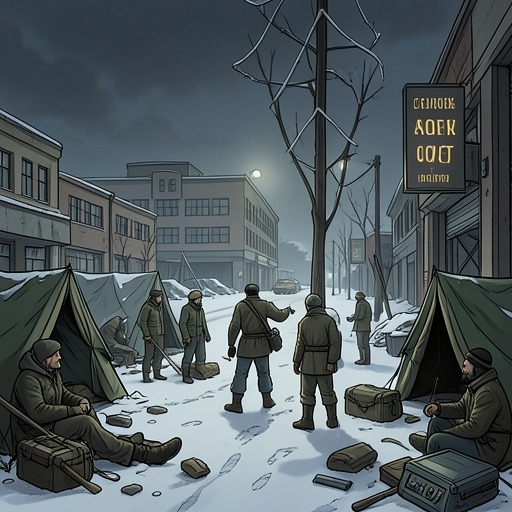
The roads show the same collapse in mobility. Traffic initially inches forward as people leave with trailers, luggage, children, and pets, but the expressway becomes a gridlock that no longer leads anywhere. By the time gasoline has gone stale, movement by motor vehicle is largely out of reach. The old expectation of easy travel gives way to walking, settlement, or remaining where one has become stranded. At Severn City Airport, the stranded passengers shift from waiting for rescue to organizing food and shelter themselves. They break into airport businesses for provisions, and a scouting party returns with supplies from an unlooted restaurant. A roadblock warns of quarantine; beyond it, abandoned cars and the absence of other people make clear that the airport has not been cut off from an otherwise functioning world. It is part of the same failure.
From mass movement to local settlement
In the first years after the pandemic, people travel because they have not yet understood that there is nowhere they can reach where life continues as before. They cluster in former truck stops, restaurants, motels, and other places where people can stay close enough to offer one another safety. As fuel supplies dwindle and walking cannot be sustained indefinitely, this widespread movement gives way to settlement. Communities become small and locally organized, shaped by what their members can grow, salvage, maintain, and defend.
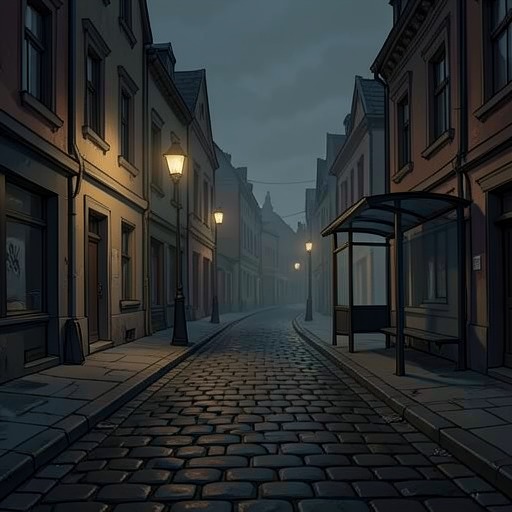
The later landscape is an archipelago of towns rather than a unified society. These settlements have endured violence, loss, and hardship, and their experience makes them wary of outsiders. Their caution reflects both danger and the practical limits of trust in a world where help cannot be summoned from distant institutions. The people who form durable communities do so by holding together over time; their security rests on relationships and shared work rather than on services that once seemed automatic.
The Travelling Symphony offers a different adaptation to those conditions. Five years after the collapse, its conductor leaves an air base with members of her military orchestra and sets out into the changed landscape. After months of travel, the group meets Gil’s company of Shakespearean actors, who had escaped from Chicago, worked on a farm, and then taken to the road. The two groups combine. Twenty years after the collapse, the Travelling Symphony continues to move among settlements around Lakes Huron and Michigan, performing music and Shakespeare. Its life on the road depends on horses and caravans rather than fuel-powered transport, and its performances connect communities without restoring the old systems that once linked them.
The new society is not defined only by permanent settlement. Jeevan walks a thousand miles before reaching McKinley, a settlement established by eight people stranded at a corporate retreat. Their former sales team finds an abandoned motel away from the major highways and stays first because the early years are dangerous, then because a shared home has taken shape there. By Year Fifteen, McKinley has twenty-seven families. Jeevan marries Daria, one of its founders, in Year Ten. His route from a city apartment to a distant settlement makes the scale of post-collapse movement concrete, while the community’s growth shows how temporary refuge can become a lasting social structure.
Memory, objects, and the new measure of time
At Severn City Airport, the first inhabitants initially count the days as if their confinement will end with a flight. That expectation gives way to a new calendar: Day One, Day Two, and the numbered days of the emergency eventually yield to Year One, Year Two, and the years counted from the catastrophe. In Year Four, Clark understands that this is how time will be measured from then on. The change in the calendar turns the Collapse into a permanent historical boundary. Ordinary experiences acquire the shape of last times: the last bus in motion, the last flight that actually takes off, the last orange eaten in the old world.
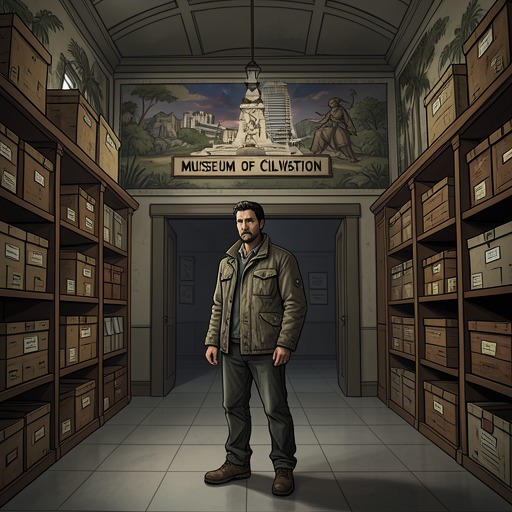
The airport also changes from a temporary holding place into a settlement. People salvage supplies, hunt, grow crops, and take over abandoned spaces. By Year Fifteen, three hundred people live there, and Clark’s Museum of Civilization fills the Skymiles Lounge. He begins the collection with a discarded phone, a credit card, a driver’s licence, and his laptop, displayed in a case that once held sandwiches. Others add objects, including another phone, red high heels, and a snow globe. The museum preserves things that have little practical use in the new circumstances, but whose making depended on a vast chain of human labor: the snow globe recalls design, factory work, shipping, and delivery. Its beauty points back to the relationships and work hidden inside the old world’s ordinary goods.
That attention to the past is set against the daily demands of survival. Early on, Clark gathers firewood, hauls water to keep the toilets usable, joins salvage expeditions, plants crops, and skins deer. As the airport population grows, caring for the museum becomes possible as other people share the work. The collection is not a replacement for the lost infrastructure; it is a record of what that infrastructure made and of the human effort that once passed unnoticed through everyday life.
Long aftermath and significance
The Collapse reshapes both the material world and the terms on which people live together. Aircraft remain on runways and in hangars, but no longer carry passengers; some become storage spaces for food. The networks of flight, electricity, medicine, communication, and commerce do not simply pause until normal service resumes. They become remnants of a previous order, available for salvage or memory but no longer capable of restoring it. In their place, people rely on local resources, practical knowledge, and the often difficult work of living together.
The novel presents this transformation through contrasts: the speed and reach once promised by planes against the slow movement of caravans; a city’s hidden labor against the isolation of a powerless apartment; abandoned consumer objects against the care with which Clark preserves them. The quiet that follows the disappearance of broadcasts and traffic is not emptiness alone. It reveals how much coordination the former world required, and how much of that coordination had been invisible until it stopped.
The surviving communities do not recreate the old world in miniature. The Travelling Symphony’s performances, the Museum of Civilization, and the settled life of places such as McKinley are distinct responses to the same break: cultural memory, collective practice, and local belonging take on new importance when large systems can no longer guarantee continuity. The Collapse thus marks both an ending and a change in scale. Life continues, but its supports must be made visible, shared, and repeatedly renewed by the people who remain.